Filter Delays
Three filtered stereo delays [2026]
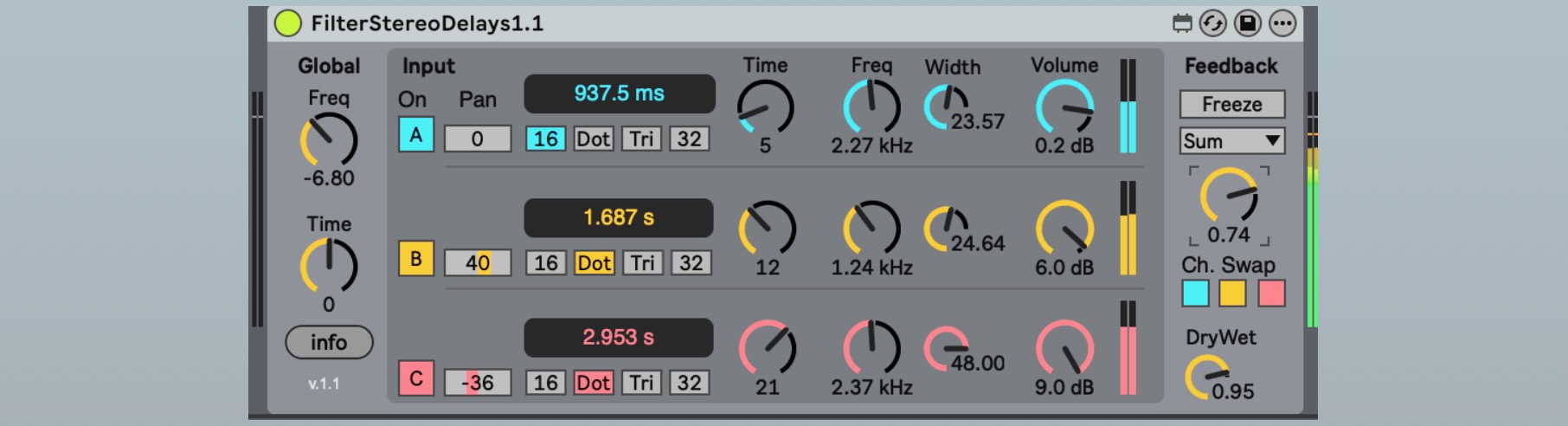
Three filtered delays providing endless rhythmical fun.
You can download the Max for Live device and a Demo Live Set here: [Download (Version 1.1, June 30th 2026)]. It has been tested with Ableton Live Suite 12, but might also work in earlier versions of Live.
Basics
The device consists of three stereo delays, with delay times expressed in rhythmic values. The output of each delay is processed with a low-pass and high-pass filter in series, allowing the signal to be narrowed to a specific part of the spectrum. Either each delay individually or the sum of all delays can be fed back to the input for repeated echoes.
A Freeze function and sophisticated panning are provided.
Time
Three controls define the duration of the delays: A Time multiplier is applied to a basic beat grid defined in the Grid selector. This can be 16th notes, dotted 16th, 16th triplets, or 32nd notes. Time allows the delay to be set from 1 to 32 times this base grid value, independently for each delay line. A Global Time Shift control allows you to subtract from or add to these delay times. The current delay time is displayed in milliseconds or seconds for reference. The maximum delay time is 10 seconds at 96Khz (this is 23 seconds at 44.1kHz).
Filter
The filters in each delay are controlled by two parameters: center Frequency and Width - in semitones around the center. A Global Frequency control allows to shift all filters together. This is an ideal parameter to play with or automate.
Pan
The Pan controls affects the input to each delay. It does more than a standard panner: values above 50 or below -50 ‘fold’ the panning back with inverted phase.
At the extremes of 99 or -99, the signal is panned to the center again but ‘180° out of phase’. This can produce dramatic stereo effects but should be used with caution when mono-compatibility is a concern.Since Pan is applied before the signal enters the delay line, it has no effect whilst the delay is in Freeze mode.
Feedback
Repeated echos can be achieved by feeding the output of the delays back to their inputs. This devices offers one common Feedback control and several Feedback Routing options: Ind feeds back each individual delay line to its own input. Sum adds all outputs and feeds them back to all inputs, creating more complex delay patterns.
In Sum mode, the feedback can exceed unity gain, which allows to create 'growing' feedbacks when set near maxium. In this mode the feedback is saturated to avoid infinite runaway. By lowering the output volume of each delay, signals can be constrained to useful levels.
Freeze
Enabling Freeze loops back the output of each delay to its input and disables external input. Whilst in Freeze state, the filters are still active at the output.
Swap
The left and right output of each stereo delay line can be remapped to right and left using the Channel Swap toggles. This also affects the feedback signal. In conjunction with Pan a wide range of interesting stereo effects can achieved this way.
And there is a Dry/Wet control. Of course.
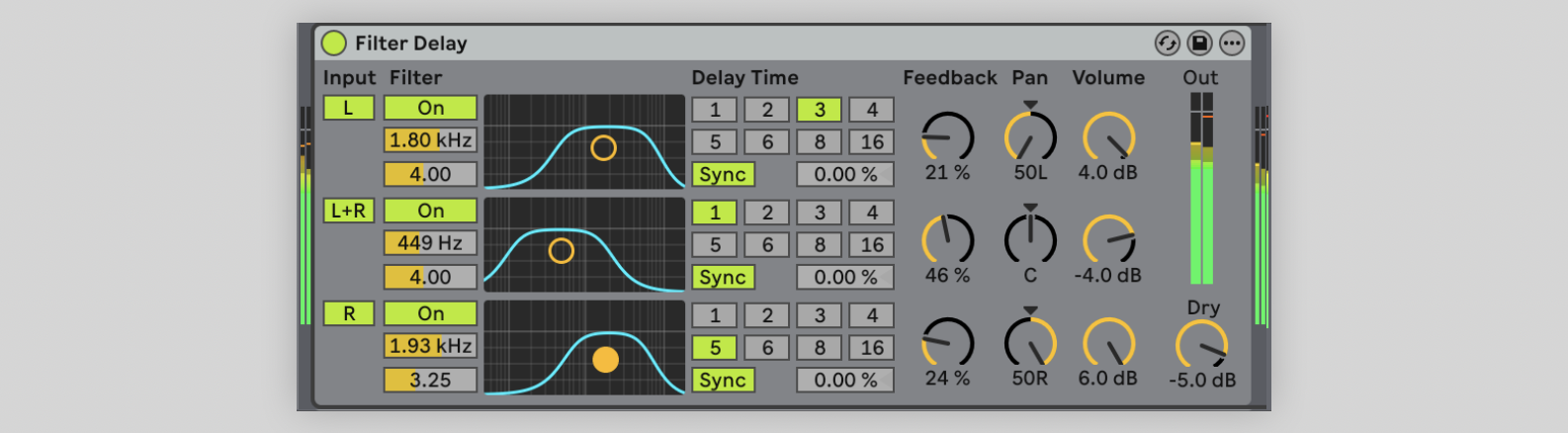
Legacy
I wrote the original Ableton Filter Delay for Live 1.0, released in 2001. Recently, I rediscovered it and wanted to have a few more options that were missing in the Ableton device. This led me to create a new version in Max4Live.
The Filter Delay was one of the first devices I developed, partly inspired by the filtered delays in my Lexicon PCM 80. Back then, CPU limitations were a major concern, so the original effect only includes three mono delays and less flexible feedback routing.
I made the Filter Delays device in February 2026 because I needed it for my music. It has been tested and should work, but if there are issues, get in touch.